America is working hard to revive its manufacturing base, and the investment numbers back that up. But national manufacturing employment still fell for a third straight year in 2025, a sign that the jobs being announced and the workers available to fill them aren't tracking. For plant operations leaders and talent teams, that gap is a direct threat to line availability and plant uptime.
The shortage sits in trained technicians specifically, the people who operate, maintain, troubleshoot, and repair automated systems, rather than in the manufacturing workforce as a whole. Rising retirements are one of the biggest reasons that the gap keeps growing.
The Reshoring Boom Is Real
In 2024, companies announced 244,000 new manufacturing jobs in the U.S., driven by foreign direct investment (FDI) and reshoring. That trend started in 2010, and over 2 million jobs have been created since.
A few forces are fueling this surge. The semiconductor industry alone has pulled in more than $820.8 billion in private investment since 2020. At the same time, construction spending on new manufacturing capacity has climbed just as quickly, rising 185% between 2020 and 2025, from $75 billion to $215 billion.
New Manufacturing Jobs Are More Technical
These aren't the assembly-line jobs of decades past. According to the Reshoring Initiative, 88% of the jobs announced in 2024 are mid- or high-tech, and that share rose to 90% in 2025.

Employment Isn't Following the Investment
Despite that investment, manufacturing employment fell by 90,000 in 2025, the third such decline in a row.
That doesn't mean the job announcements are hollow. The announcements represent future hiring commitments spread across multi-year projects, while the employment figures reflect the sector's current net payroll. The two numbers are simply tracking different things.
State-level data shows how this plays out on the ground. In Wisconsin, the manufacturing workforce shrank by 9,500 jobs in a single year, enough for healthcare to surpass manufacturing as the state's top employer.
Retirements Are Driving Future Demand
Retirement is the single biggest driver of new openings in this sector. A study by Deloitte and the Manufacturing Institute found that 2.8 million new jobs will come from retirements alone, with industry growth adding another 760,000 and recent legislative and regulatory action adding 230,000 more.
Gaps like Wisconsin's show up because companies aren't replacing retirees fast enough. Scott Paul, President, Alliance for American Manufacturing, notes that some firms are "opting to get more work out of their remaining workers." Others are leaning harder into automation and efficiency gains.
Where The Gap Actually Concentrates
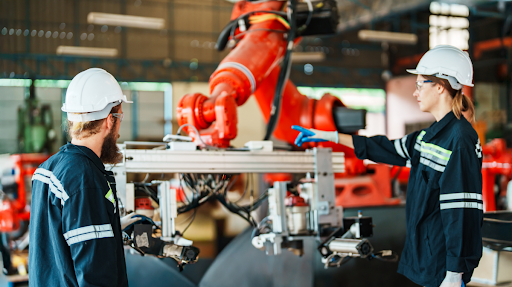
The gap specifically sits in the skilled trades that keep automated industrial equipment running, rather than in manufacturing headcount as a whole. The Bureau of Labor Statistics (BLS) projects electrical trade work tied to industrial and commercial systems will grow 9% between 2025 and 2035, adding about 72,700 openings a year. Industrial machinery mechanics, maintenance workers, and millwrights will grow even faster, 14% growth, with roughly 51,900 new jobs becoming available annually.
BLS ties this growth directly to automation. More automated equipment on the floor means more people are needed to maintain and troubleshoot it, and that demand isn't likely to slow down.
Talent is a Major Concern for Manufacturers
Talent shortages are showing up in survey after survey. In NAM's Q1 2026 outlook survey, 44.7% of manufacturing respondents cited talent issues as a top concern, alongside trade uncertainty and healthcare and insurance costs. A 2024 Deloitte and Manufacturing Institute survey of 200 manufacturing companies found that 65% named recruiting and retaining workers as their top business challenge.

Per Scholas Is Building That Talent Now
Per Scholas built its Advanced Manufacturing Technician program to close exactly this gap so manufacturers can move past temporary hiring fixes and build sustainable talent pipelines.
Per Scholas spent a full year developing the program alongside industry leaders, aligning the curriculum with what today's manufacturing floors actually need. That work is now a blueprint that Per Scholas can bring to other markets facing the same gap.
Training For the Jobs Manufacturers Actually Need
The 15-week program puts learners through 400 hours of hands-on training in industrial electricity, fluid power, motor-driven systems, troubleshooting, precision maintenance, and industrial safety and standards. Graduates also earn OSHA-10 and NFPA 70E credentials, preparing them for roles like advanced manufacturing technician, maintenance technician, electrical/instrumentation technician, and controls/automation technician.
Partner With Per Scholas
Manufacturers, plant leaders, HR teams, and talent teams can build a technician pipeline around the skills modern facilities actually require. Bring the Advanced Manufacturing Technician program to your market to future-proof your technologist pipeline, or work with Per Scholas to build a custom cohort for your existing workforce.
Contact Per Scholas Talent Solutions to bring the Advanced Manufacturing Technician program to your market or discuss a custom cohort.