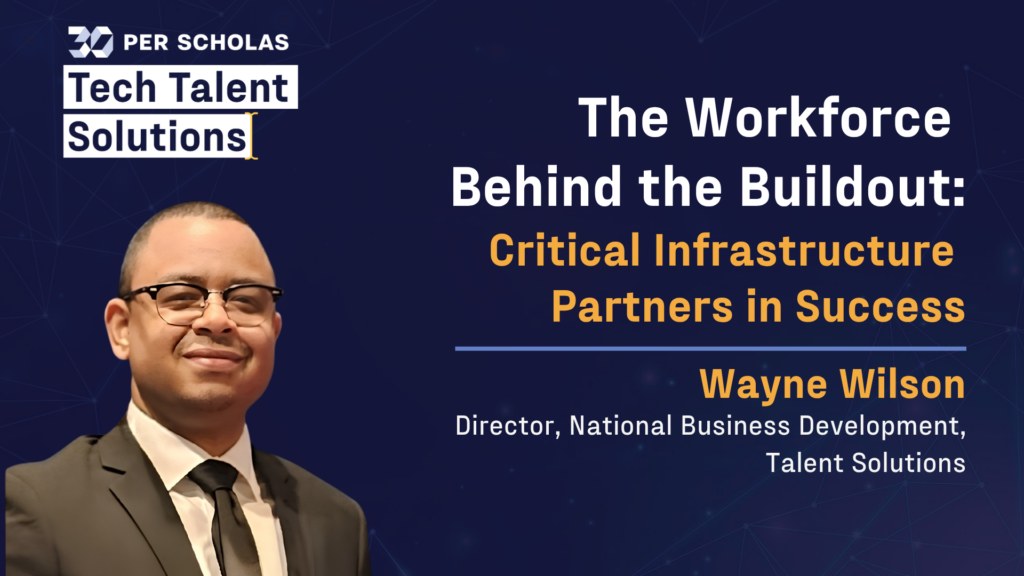
I had the chance to moderate the Critical Infrastructure Partners in Success virtual panel on July 28th, and the conversation stayed with me long after it ended. I came away from the panel reminded of what non-traditional training pathways can produce, not only because of what the panelists and I discussed, but because it's part of my life experience. Long before building a career in non-profit business development, I sat in a classroom as a student in the Software Engineering program at Per Scholas.
That personal context shaped how I heard our panelists discuss how tight the talent market has become for critical infrastructure like data centers. Jaime Winkel, Manager of Marketplace Inclusion at TEKsystems, put things into perspective with raw numbers. She noted there are over 3,100 operational data centers in the United States, 1,400 planned facilities, and nearly 400 actively under construction. Most projects are clustered in the same major metropolitan areas. They all compete for the same critical infrastructure workforce.
Bridging the Gap by Creating New Possibilities
At Per Scholas, we actively work to bridge that gap by creating possibilities for learners who fall outside of traditional training opportunities. Fellow program alum Aasif Allen, now a Data Center Technician at Microsoft, reminded me of this. Aasif transitioned from the restaurant industry with no prior IT experience. Listening to him, I recognized the familiar feeling of sitting on the other side of an opportunity divide.
"Before Per Scholas, I actually had no IT experience at all," Aasif said. "I applied to Microsoft on my own, and unfortunately, I wasn't selected. But after completing the program, I got that opportunity."
He's not alone in his experience. Fifteen of his twenty cohort members came from the same background, one that traditionally might not have led them to data center technician training.
Transferring Skills Through a Mindset Shift
Aasif's story points to a harder question: how do you actually train someone to thrive in a critical infrastructure environment? John Crescenzo, Director of Product and SME for Advanced Manufacturing at our organization, brought some interesting perspectives to the conversation. John is a United States Navy veteran and former Nuclear Electrician with over 15 years of experience designing training for complex industrial environments.
John explained that candidates from non-tech industries bring highly transferable skills from roles in manufacturing, power generation, and facility maintenance. He described how those roles require a capacity for diagnosis and root-cause thinking. Part of what makes Per Scholas training so great is a mindset shift that helps learners move away from executing tasks in isolation toward understanding how interconnected systems constantly affect one another.
"In a data center, turning a wrench isn't just turning a wrench. It's when, where, why, and how to turn that wrench in a safe way such that you're not going to harm yourself, the equipment, or cause an upset in the whole environment," John said.
He then discussed a scenario where this shift in thinking might come into play:
"If I have my thermostat set to 72 degrees and it's 73, I'm fine. No big deal. But in a data center, if I have a temperature set to 72 degrees and it's 73, is there a problem in the aisle? Is there an airflow issue? Is one of our servers producing too much excess heat? Is a fan down or not operating the way it should be? There are a number of different things to consider from just what seems to be a minor one-degree shift."

Higher Employee Retention in a Skills-Based Marketplace
Jaime, who has partnered with us for five years as part of a relationship with Per Scholas spanning over a decade, talked about how building on existing skill sets helps bridge the data center talent gap. She said that traditional approaches to hiring are reaching their limits, but skills-based hiring is proving to be highly effective.
Jaime was direct about what that difference looks like in practice. The open market can no longer reliably produce the talent her clients need, but graduates from non-traditional pathways bring something different to the table. TEKsystems sees retention rates of 90% or higher one year after Per Scholas alumni enter their program. Through my own role in business development, I understand the importance of employee retention for our employer partners.
Jaime put it better than I could have:
"When you hire from Per Scholas, you're not getting a traditional candidate. You're getting someone who has made a significant sacrifice and investment in themselves to start a new career. They are highly motivated and reliable because they've sacrificed and they've made that investment. That professional aptitude and attitude component is something we've just found priceless."
A New Approach to Workforce Development
Per Scholas believes that tech industry workforce development is shifting toward skills-based hiring, particularly for the critical infrastructure workforce. To explore how a pipeline partnership can meet your hiring needs, connect with Per Scholas Tech Talent Solutions. Also, make sure to watch the full panel recording to hear the full conversation we had.